December 12, 2016

VLT image of the area around the very faint neutron star RX J1856.5-3754

VLT image of the area around the very faint neutron star RX J1856.5-3754

Colour composite photo of the sky field around the lonely neutron star RX J1856.5-3754 and the related cone-shaped nebula. It is based on a series of exposures obtained with the multi-mode FORS2 instrument at VLT KUEYEN through three different optical filters. The trail of an asteroid is seen in the field with intermittent blue, green and red colours. RX J1856.5-3754 is exactly in the centre of the image.

Image Credit: ESO

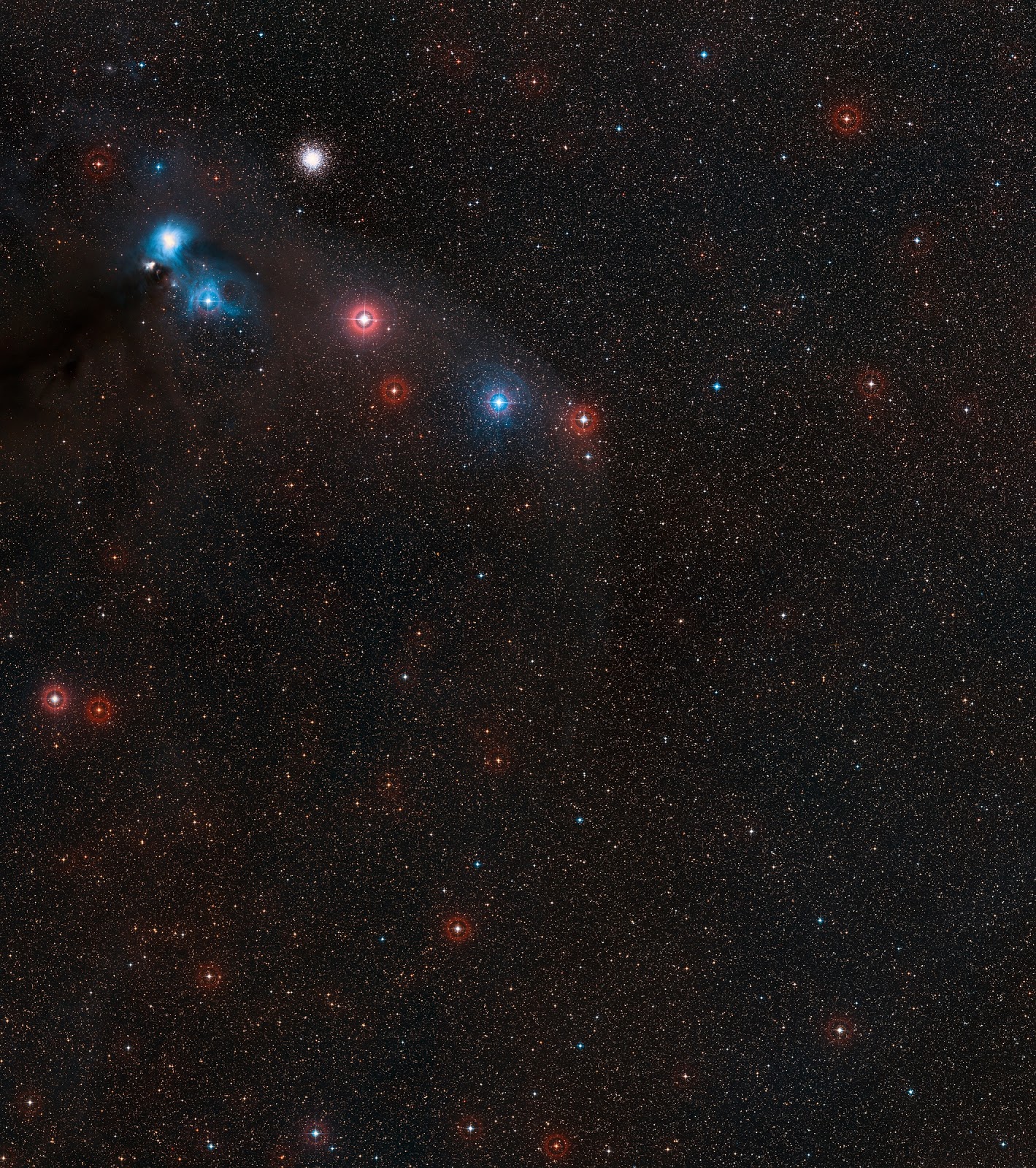
Wide field view of the sky around the very faint neutron star RX J1856.5-3754

Wide field view of the sky around the very faint neutron star RX J1856.5-3754

This wide field image shows the sky around the very faint neutron star RX J1856.5-3754 in the southern constellation of Corona Australis. This part of the sky also contains interesting regions of dark and bright nebulosity surrounding the variable star R Coronae Australis (upper left), as well as the globular star cluster NGC 6723. The neutron star itself is too faint to be seen here, but lies very close to the centre of the image.

Image Credit: ESO/Digitized Sky Survey 2, Davide De Martin

The polarisation of light emitted by a neutron star

The polarisation of light emitted by a neutron star

This artist’s view shows how the light coming from the surface of a strongly magnetic neutron star (left) becomes linearly polarised as it travels through the vacuum of space close to the star on its way to the observer on Earth (right). The polarisation of the observed light in the extremely strong magnetic field suggests that the empty space around the neutron star is subject to a quantum effect known as vacuum birefringence, a prediction of quantum electrodynamics (QED). This effect was predicted in the 1930s but has not been observed before.

The magnetic and electric field directions of the light rays are shown by the red and blue lines. Model simulations by Roberto Taverna (University of Padua, Italy) and Denis Gonzalez Caniulef (UCL/MSSL, UK) show how these align along a preferred direction as the light passes through the region around the neutron star. As they become aligned the light becomes polarised, and this polarisation can be detected by sensitive instruments on Earth.

Image Credit: ESO/L. Calçada
Explanation from: http://www.eso.org/public/images/eso1641a/