April 25, 2017

Red Panda

Red PandaRed PandaRed PandaRed PandaRed PandaRed PandaRed PandaRed PandaRed Panda

The red panda is a mammal native to the eastern Himalayas and southwestern China. It has reddish-brown fur, a long, shaggy tail, and a waddling gait due to its shorter front legs; it is slightly larger than a domestic cat. It is arboreal, feeds mainly on bamboo, but also eats eggs, birds, and insects. It is a solitary animal, mainly active from dusk to dawn, and is largely sedentary during the day.

The red panda has been classified as Endangered by the IUCN because its wild population is estimated at less than 10,000 mature individuals and continues to decline due to habitat loss and fragmentation, poaching, and inbreeding depression, although red pandas are protected by national laws in their range countries.

The red panda is the only living species of the genus Ailurus and the family Ailuridae. It has been previously placed in the raccoon and bear families, but the results of phylogenetic analysis provide strong support for its taxonomic classification in its own family Ailuridae, which, along with the weasel, raccoon and skunk families is part of the superfamily Musteloidea. Two subspecies are recognized. It is not closely related to the giant panda.

Explanation from: https://en.wikipedia.org/wiki/Red_panda

The Far Side of the Moon

The Far Side of the Moon

Because the Moon is tidally locked (meaning the same side always faces Earth), it was not until 1959 that the farside was first imaged by the Soviet Luna 3 spacecraft (hence the Russian names for prominent farside features, such as Mare Moscoviense). And what a surprise -­ unlike the widespread maria on the nearside, basaltic volcanism was restricted to a relatively few, smaller regions on the farside, and the battered highlands crust dominated. A different world from what we saw from Earth.

Of course, the cause of the farside/nearside asymmetry is an interesting scientific question. Past studies have shown that the crust on the farside is thicker, likely making it more difficult for magmas to erupt on the surface, limiting the amount of farside mare basalts. Why is the farside crust thicker? That is still up for debate, and in fact several presentations at this week's Lunar and Planetary Science Conference attempt to answer this question.

The Clementine mission obtained beautiful mosaics with the sun high in the sky (low phase angles), but did not have the opportunity to observe the farside at sun angles favorable for seeing surface topography. This WAC mosaic provides the most complete look at the morphology of the farside to date, and will provide a valuable resource for the scientific community. And it's simply a spectacular sight!

The Lunar Reconnaissance Orbiter Camera (LROC) Wide Angle Camera (WAC) is a push-frame camera that captures seven color bands (321, 360, 415, 566, 604, 643, and 689 nm) with a 57-km swath (105-km swath in monochrome mode) from a 50 km orbit. One of the primary objectives of LROC is to provide a global 100 m/pixel monochrome (643 nm) base map with incidence angles between 55°-70° at the equator, lighting that is favorable for morphological interpretations. Each month, the WAC provides nearly complete coverage of the Moon under unique lighting. As an added bonus, the orbit-to-orbit image overlap provides stereo coverage. Reducing all these stereo images into a global topographic map is a big job, and is being led by LROC Team Members from the German Aerospace Center (Deutsches Zentrum für Luft- und Raumfahrt; DLR). Several preliminary WAC topographic products have appeared in LROC featured images over the past year (Orientale basin, Sinus Iridum).

Image Credit: NASA/Goddard/Arizona State University.
Explanation from: https://www.nasa.gov/mission_pages/LRO/news/lro-farside.html

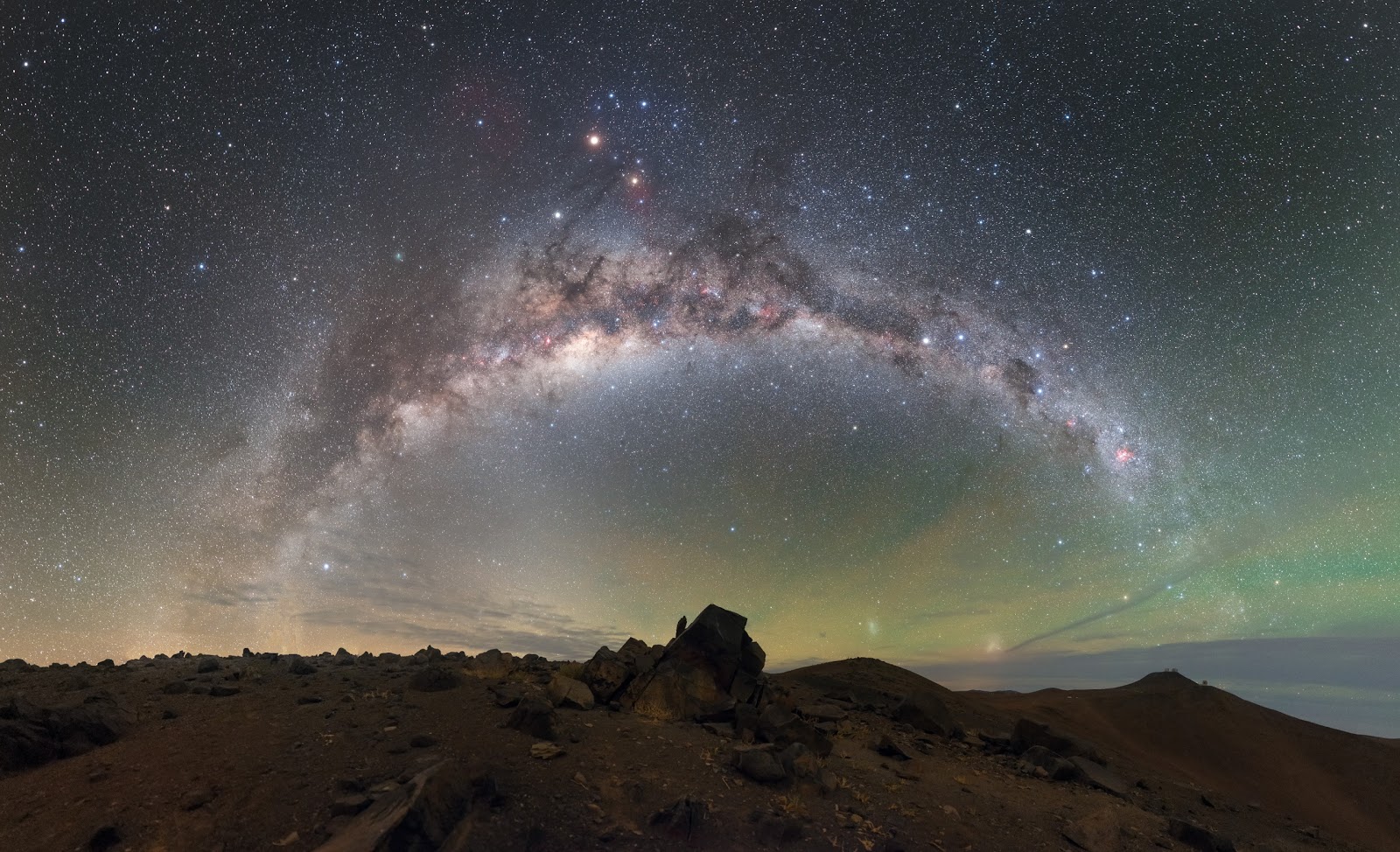
Airglow and the Milky Way Galaxy

Airglow and the Milky Way Galaxy

The skies above ESO’s Paranal Observatory resemble oil on water in this picture, as greens, yellows, and blues blend to create an iridescent skyscape.

The rocky, barren landscape below evokes an image of an alien world, perfectly complementing the shimmering cosmic display occurring above. The main feature is our beautiful home galaxy, the Milky Way, arching across the Chilean night sky and framing the awestruck observer on the left. The light from billions of stars combines to create the Milky Way’s glow, with huge clouds of dark dust blocking the light here and there and creating the dark and mottled pattern we observe. A natural effect known as airglow is responsible for the swathes of green and orange light that appear to be emanating from the horizon.

ESO’s Very Large Telescope can be seen as a speck in the distant background to the right atop Cerro Paranal. Its neighbour, slightly lower down, is the Visible and Infrared Survey Telescope for Astronomy (VISTA).

Image Credit: ESO/P. Horálek
Explanation from: https://www.eso.org/public/images/potw1715a/