August 20, 2016

Earth, Lightning Storm, Airglow and Galactic Center of the Milky Way Galaxy seen from the International Space Station

Earth, Lightning Storm, Airglow and Galactic Center of the Milky Way Galaxy seen from the International Space Station

Astronauts aboard the International Space Station (ISS) see the world at night on every orbit — that’s 16 times each crew day. An astronaut took this broad, short-lens photograph of Earth’s night lights while looking out over the remote reaches of the central equatorial Pacific Ocean. ISS was passing over the island nation of Kiribati at the time, about 2600 kilometers (1,600 miles) south of Hawaii.

Knowing the exact time and the location of the ISS, scientists were able to match the star field in the photo to charts describing which stars should have been visible at that moment. They identified the pattern of stars in the photo as our Milky Way galaxy (looking toward its center). The dark patches are dense dust clouds in an inner spiral arm of our galaxy; such clouds can block our view of stars toward the center.

The curvature of the Earth crosses the center of the image and is illuminated by a variety of airglow layers in orange, green, and red. Setting stars are visible even through the dense orange-green airglow.

The brightest light in the image is a lightning flash that illuminated a large mass of clouds. The flash reflected off the shiny solar arrays of the ISS and back to the camera. The dim equatorial cloud sheet is so extensive that it covers most of the sea surface in this view.

ISS, Orbit of the Earth
August 9, 2015

Image Credit: NASA
Explanation from: http://www.nasa.gov/image-feature/stargazing-from-the-international-space-station
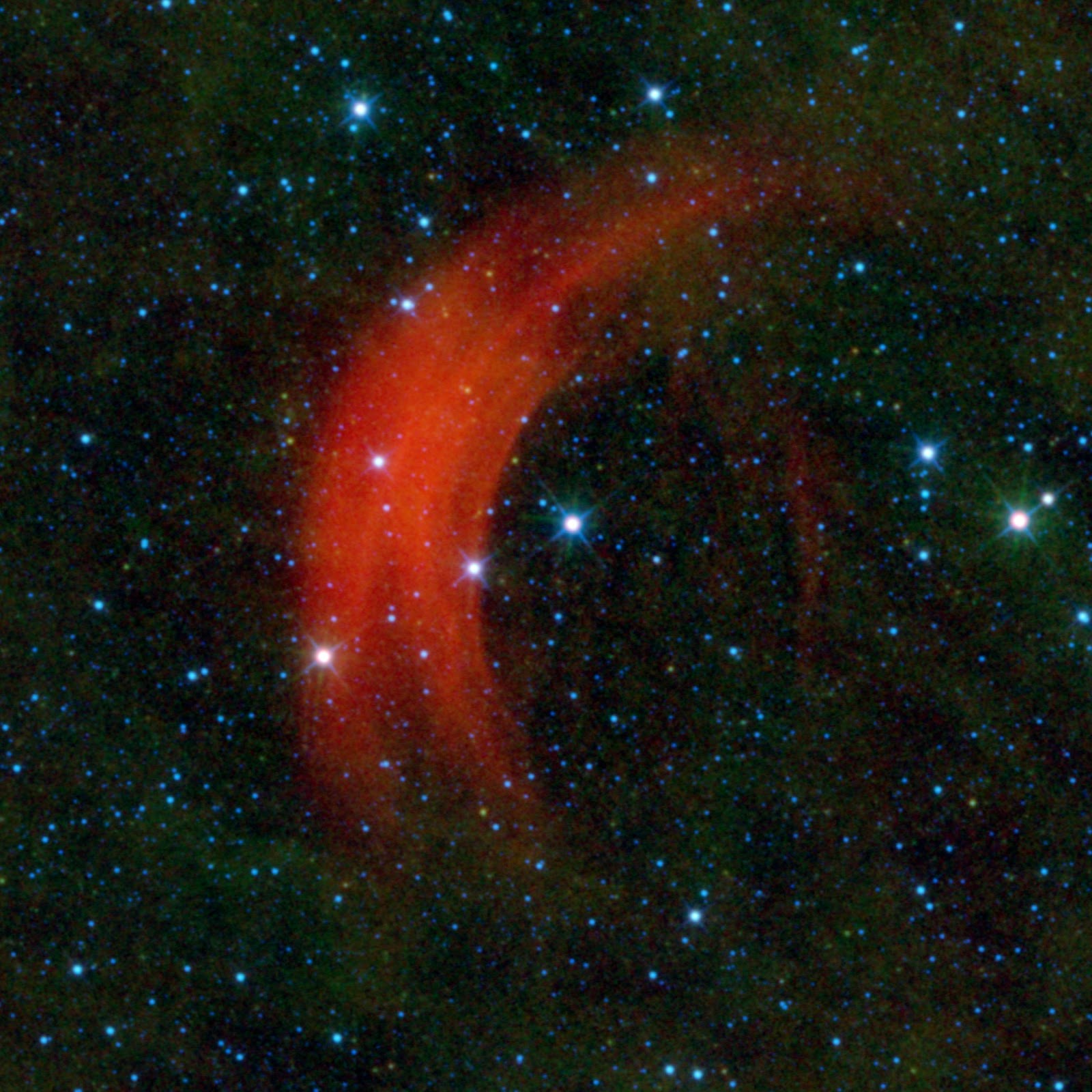
Alpha Camelopardalis

Alpha Camelopardalis

NASA's Wide-field Infrared Survey Explorer, or WISE, captured this image of the star Alpha Camelopardalis, or Alpha Cam in astronomer-speak, speeding through the sky like a motorcyclist zipping through rush-hour traffic. The supergiant star Alpha Cam is the bright star in the middle of this image, surrounded on one side by an arc-shaped cloud of dust and gas, colored red in this infrared view.

Such fast-moving stars are called runaway stars. The distance and speed of Alpha Cam is somewhat uncertain. It is probably somewhere between 1,600 and 6,900 light-years away and moving at an astonishing rate of somewhere between 680 and 4,200 kilometers per second (between 1.5 and 9.4 million miles per hour). It turns out that WISE is particularly adept at imaging bow shocks from runaway stars. Previous examples can be seen around Zeta Ophiuchi, AE Aurigae, and Menkhib. But Alpha Cam revs things up into a different gear. To put its speed into perspective, if Alpha Cam were a car driving across the United States at 4,200 kilometers per second, it would take less than one second to travel from San Francisco to New York City!

Astronomers believe runaway stars are set into motion either through the supernova explosion of a companion star or through gravitational interactions with other stars in a cluster. Because Alpha Cam is a supergiant star, it gives off a very strong wind. The speed of the wind is boosted in the forward direction the star is moving in space. When this fast-moving wind slams into the slower-moving interstellar material, a bow shock is created, similar to the wake in front of the bow of a ship in water. The stellar wind compresses the interstellar gas and dust, causing it to heat up and glow in infrared. Alpha Cam's bow shock cannot be seen in visible light, but WISE's infrared detectors show us the graceful arc of heated gas and dust around the star.

The red arc of Alpha Cam adds to collection of colorful objects in WISE images taken of the constellation Camelopardalis, or the Giraffe. The gaudily clad giraffe has what looks like a ruby choker above an emerald necklace just to the southeast, as well as an ankle bracelet.

The colors used in this image represent specific wavelengths of infrared light. Stars are seen primarily in blue and cyan (blue-green), because they are emitting light brightly at 3.4 and 4.6 microns. Green represents 12-micron light, primarily emitted by dust. The red of the blow shock represents light emitted at 22 microns.

Image Credit: NASA/JPL-Caltech/UCLA
Explanation from: http://photojournal.jpl.nasa.gov/catalog/PIA13908

Open Star Cluster IC 1590

Open Star Cluster IC 1590

Astronomers have used the NASA/ESA Hubble Space Telescope to study the young open star cluster IC 1590, which is found within the star formation region NGC 281 — nicknamed the Pacman Nebula due to its resemblance to the famous arcade game character. This image only shows the central part of the nebula, where the brightest stars at the core of the cluster are found, with part of the Pacman’s hungry mouth visible as the dark region below.

But Pacman isn’t gobbling up these stars. Instead, the nebula’s gas and dust are being used as raw ingredients to make new stars. However, the stars in IC 1590 are still plotting their escape from the Pacman Nebula, as open clusters are only loosely bound together and the grouping will eventually disperse within a few tens of millions of years.

IC 1590 lies about ten thousand light-years from Earth in the constellation of Cassiopeia (The Queen). Through small telescopes the core of the cluster that appears at the top of this picture shows up as a triple star, but the nebula that surrounds it is much fainter and very hard to see. The eagle-eyed American astronomer E. E. Barnard, using a 15 cm telescope, first recorded it in the late nineteenth century.

This picture was created from images taken using the Wide Field Channel of Hubble’s Advanced Camera for Surveys. Images though yellow (F550M, coloured blue), orange (F660N, coloured green) and red (F658N) filters were combined. The F658N filter isolates light from glowing hydrogen gas. The total exposure times per filter were 450 s, 1017 s and 678 s, respectively and the field of view is about 3.3 arcminutes across.

Image Credit: ESA/Hubble & NASA
Explanation from: https://www.spacetelescope.org/images/potw1115a/