January 31, 2017

Full-Circle Rainbow over Cottesloe Beach

Full-Circle Rainbow over Cottesloe Beach

Cottesloe Beach, Western Australia, Australia
2013

Image Credit & Copyright: Colin Leonhardt

Building Planets Through Collisions

Building Planets Through Collisions

Planets, including those like our own Earth, form from epic collisions between asteroids and even bigger bodies, called proto-planets. Sometimes the colliding bodies are ground to dust, and sometimes they stick together to ultimately form larger, mature planets.

This artist's conception shows one such smash-up, the evidence for which was collected by NASA's Spitzer Space Telescope. Spitzer's infrared vision detected a huge eruption around the star NGC 2547-ID8 between August 2012 and 2013. Scientists think the dust was kicked up by a massive collision between two large asteroids. They say the smashup took place in the star's "terrestrial zone," the region around stars where rocky planets like Earth take shape.

NGC 2547-ID8 is a sun-like star located about 1,200 light-years from Earth in the constellation Vela. It is about 35 million years old, the same age our young sun was when its rocky planets were finally assembled via massive collisions -- including the giant impact on proto-Earth that led to the formation of the moon. The recent impact witnessed by Spitzer may be a sign of similar terrestrial planet building. Near-real-time studies like these help astronomers understand how the chaotic process works.

Image Credit: NASA/JPL-Caltech
Explanation from: http://photojournal.jpl.nasa.gov/catalog/PIA18469

The Calabash Nebula

Calabash Nebula

The Calabash Nebula — which has the technical name OH 231.8+04.2 — is a spectacular example of the death of a low-mass star like the Sun. This image taken by the NASA/ESA Hubble Space Telescope shows the star going through a rapid transformation from a red giant to a planetary nebula, during which it blows its outer layers of gas and dust out into the surrounding space. The recently ejected material is spat out in opposite directions with immense speed — the gas shown in yellow is moving close to a million kilometres an hour.

Astronomers rarely capture a star in this phase of its evolution because it occurs within the blink of an eye — in astronomical terms. Over the next thousand years the nebula is expected to evolve into a fully fledged planetary nebula.

The nebula is also known as the Rotten Egg Nebula because it contains a lot of sulphur, an element that, when combined with other elements, smells like a rotten egg — but luckily, it resides over 5000 light-years away in the constellation of Puppis (The Poop deck).

Image Credit: ESA/Hubble & NASA, Judy Schmidt
Explanation from: https://www.spacetelescope.org/images/potw1705a/

January 30, 2017

Mammatus Clouds over Kansas

Mammatus Clouds over Kansas

Kansas, USA

Image Credit & Copyright: Terry Koyama

Saturn's moon Dione

Saturn's moon Dione

Dione's lit hemisphere faces away from Cassini's camera, yet the moon's darkened surface features are dimly illuminated in this image, due to Saturnshine.

Although direct sunlight provides the best illumination for imaging, light reflected off of Saturn can do the job as well. In this image, Dione (698 miles or 1,123 kilometers across) is above Saturn's day side, and the moon's night side is faintly illuminated by sunlight reflected off the planet's disk.

This view looks toward the Saturn-facing side of Dione. North on Dione is up and rotated 8 degrees to the right. The image was taken in visible light with the Cassini spacecraft narrow-angle camera on October 23, 2016.

The view was obtained at a distance of approximately 313,000 miles (504,000 kilometers) from Dione. Image scale is 1.8 miles (3 kilometers) per pixel.

Image Credit: NASA/JPL-Caltech/Space Science Institute
Explanation from: http://photojournal.jpl.nasa.gov/catalog/PIA20514

South Polar region of Mars

South Polar region of Mars

Ground that has a lot of water ice mixed with dirt tends to crack in polygonal patterns bounded by short straight channels. In the South Polar region of Mars this type of terrain may be covered by a seasonal polar cap composed of dry ice.

In the spring as the seasonal cap sublimates gas is trapped underneath the seasonal ice layer until it can escape to an opening. At this site, faint rectangular channels in the surface are visible. The escaping carbon dioxide gas has exploited these channels and in the process, deepened them and added sinuosity to the formerly straight segments.

Image Credit: NASA/JPL-Caltech/Univ. of Arizona
Explanation from: http://photojournal.jpl.nasa.gov/catalog/PIA11238

January 29, 2017

Volcán de Colima Eruption

Volcán de Colima Eruption

Colima, Mexico
November 2015

Image Credit & Copyright: Sergio Tapiro

Jet near a Black Hole in Messier 87

Jet near a Black Hole in Messier 87

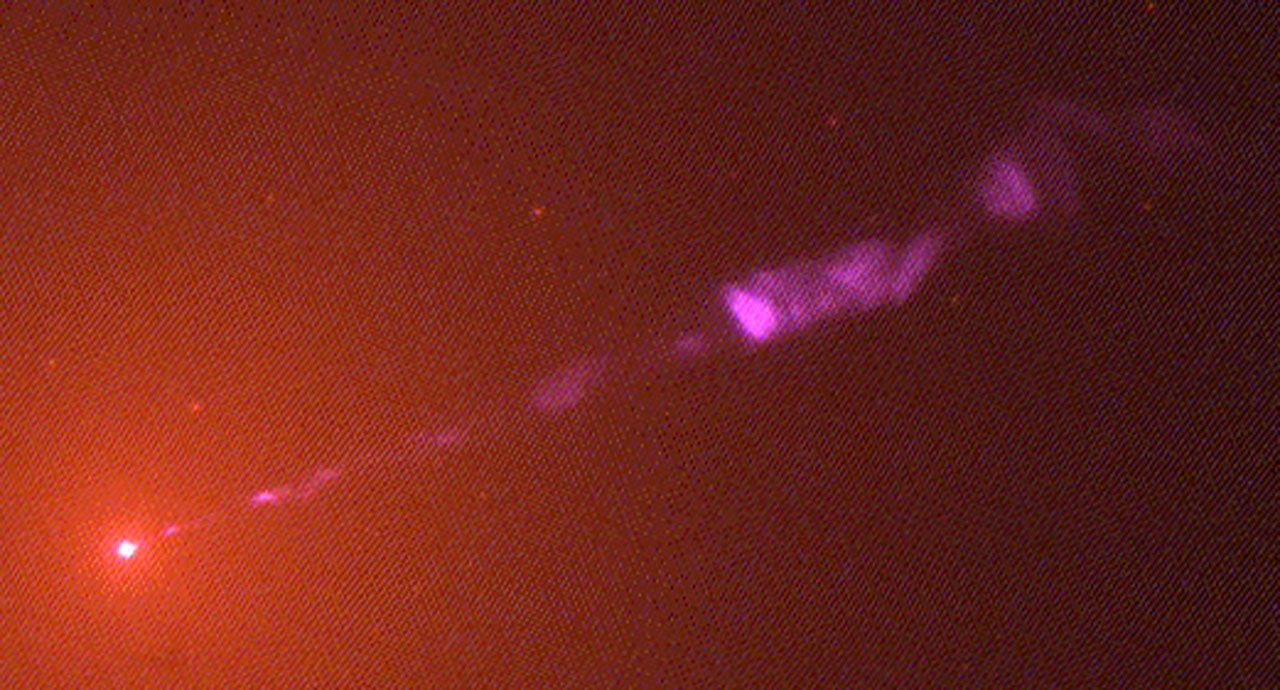
A visible light image of the giant elliptical galaxy M 87, taken with the NASA/ESA Hubble Space Telescope's Wide Field Planetary Camera 2 in February 1998, reveals a brilliant jet of high-speed electrons emitted from the nucleus (diagonal line across image). The jet is produced by a 3-billion-solar-mass black hole.

Image Credit: NASA/ESA and John Biretta (STScI/JHU)

N70 in the Large Magellanic Cloud Galaxy

N70 in the Large Magellanic Cloud Galaxy

This image shows a three-colour composite of the N 70 nebula. It is a "Super Bubble" in the Large Magellanic Cloud (LMC), a satellite galaxy to the Milky Way system, located in the southern sky at a distance of about 160,000 light-years. This photo is based on CCD frames obtained with the FORS2 instrument in imaging mode in the morning of November 5, 1999. N 70 is a luminous bubble of interstellar gas, measuring about 300 light-years in diameter. It was created by winds from hot, massive stars and supernova explosions and the interior is filled with tenuous, hot expanding gas. An object like N70 provides astronomers with an excellent opportunity to explore the connection between the life-cycles of stars and the evolution of galaxies. Very massive stars profoundly affect their environment. They stir and mix the interstellar clouds of gas and dust, and they leave their mark in the compositions and locations of future generations of stars and star systems.

Image Credit: ESO
Explanation from: https://www.eso.org/public/images/eso9948d/

January 28, 2017

Supercell over France

Supercell over France

Champagne-Ardenne, France
2014

Image Credit & Copyright: Maximilian Conrad

Gas Plume Near the Edge of the Orion Nebula


A NASA Hubble Space Telescope mosaic image of a small portion of the Orion Nebula, taken the Wide Field and Planetary Camera (in wide field mode).

Hubble shows a wealth of detail never seen before in the nebula. New features include: elongated objects oriented on the brightest stars in this region (which are located just off the edge of the picture); rapidly expanding plumes of material around young stars; and protoplanetary disks.

This color photograph is a composite of separate images taken at the wavelengths of three abundant elements in the nebula: Hydrogen, Oxygen and Nitrogen. The images were taken August 13 and 14, 1991.

The image is 1.29 light-years across.

Image Credit: C.R. O'Dell (Rice University), and NASA
Explanation from: https://www.spacetelescope.org/images/opo9229a/

Ring Galaxy NGC 922

Ring Galaxy NGC 922

Bright pink nebulae almost completely encircle a spiral galaxy in this NASA/ESA Hubble Space Telescope image of NGC 922. The ring structure and the galaxy’s distorted spiral shape result from a smaller galaxy scoring a cosmic bullseye, hitting the centre of NGC 922 some 330 million years ago.

In Hubble’s image, NGC 922 clearly reveals itself not to be a normal spiral galaxy. The spiral arms are disrupted, a stream of stars extends out towards the top of the image, and a bright ring of nebulae encircles the core. Observing with NASA’s Chandra X-ray Observatory reveals more chaos in the form of ultraluminous X-ray sources dotted around the galaxy.

NGC 922’s current unusual form is a result of a cosmic bullseye millions of years ago. A smaller galaxy, catalogued as 2MASXI J0224301-244443, plunged right through the heart of NGC 922 and shot out the other side. In wide-field views of the NGC 922, the small interloper can be still be seen shooting away from the scene of the crash.

As the small galaxy passed through the middle of NGC 922, it set up ripples that disrupted the clouds of gas, and triggered the formation of new stars whose radiation then lit up the remaining gas. The bright pink colour of the resulting nebulae is a characteristic sign of this process, and it is caused by excited hydrogen gas (the dominant element in interstellar gas clouds). This process of excitation and emission of light by gases is similar to that in neon signs.

In theory, if two galaxies are aligned just right, with the small one passing through the centre of the larger one, the ring of nebulae should form a perfect circle, but more often the two galaxies are slightly off kilter, leading to a circle that, like this one, is noticeably brighter on one side than the other.

These objects, called collisional ring galaxies, are relatively rare in our cosmic neighbourhood. Although galaxy collisions and mergers are commonplace, the precise alignment and ratio of sizes necessary to form a ring like this is not, and the ring-like phenomenon is also thought to be relatively short-lived.

The chances of seeing one of these galaxies nearby is therefore quite low. Despite the immense number of galaxies in the Universe, this is one of only a handful known in our cosmic neighbourhood. Observations of the more distant Universe (where we see further into the past) show that these rings were more common in the past, however.

Hubble’s image of NGC 922 consists of a series of exposures taken in visible light with Hubble’s Wide Field Camera 3, and in visible and near-infrared light with the Wide Field and Planetary Camera 2.

Image Credit: NASA, ESA
Explanation from: https://www.spacetelescope.org/news/heic1218/

January 27, 2017

Flying Through an Aurora

Flying Through an Aurora

The dancing lights of the aurora provide spectacular views on the ground, but also capture the imagination of scientists who study incoming energy and particles from the Sun. Aurora are one effect of such energetic particles, which can speed out from the sun both in a steady stream called the solar wind and due to giant eruptions known as coronal mass ejections or CMEs.

ISS, Orbit of the Earth
February 23, 2016

Image Credit: ESA/NASA

Artist's impression of hydrocarbon pools, icy and rocky terrain on the surface of Saturn's largest moon Titan


Saturn's orange moon Titan has hundreds of times more liquid hydrocarbons than all the known oil and natural gas reserves on Earth, according to new data from NASA's Cassini spacecraft. The hydrocarbons rain from the sky, collecting in vast deposits that form lakes and dunes.

The new findings from the study led by Ralph Lorenz, Cassini radar team member from the Johns Hopkins University Applied Physics Laboratory, Laurel, Md., are reported in the Jan. 29 issue of the Geophysical Research Letters.

"Titan is just covered in carbon-bearing material -- it's a giant factory of organic chemicals," said Lorenz. "This vast carbon inventory is an important window into the geology and climate history of Titan."

At a balmy minus 179 degrees Celsius (minus 290 degrees Fahrenheit), Titan is a far cry from Earth. Instead of water, liquid hydrocarbons in the form of methane and ethane are present on the moon's surface, and tholins probably make up its dunes. The term "tholins"was coined by Carl Sagan in 1979 to describe the complex organic molecules at the heart of prebiotic chemistry.

Cassini has mapped about 20 percent of Titan's surface with radar. Several hundred lakes and seas have been observed, with each of several dozen estimated to contain more hydrocarbon liquid than Earth's oil and gas reserves. The dark dunes that run along the equator contain a volume of organics several hundred times larger than Earth's coal reserves.

Proven reserves of natural gas on Earth total 130 billion tons, enough to provide 300 times the amount of energy the entire United States uses annually for residential heating, cooling and lighting. Dozens of Titan's lakes individually have the equivalent of at least this much energy in the form of methane and ethane.

"This global estimate is based mostly on views of the lakes in the northern polar regions. We have assumed the south might be similar, but we really don't yet know how much liquid is there," said Lorenz. Cassini's radar has observed the south polar region only once, and only two small lakes were visible. Future observations of that area are planned during Cassini's proposed extended mission.

Scientists estimated Titan's lake depth by making some general assumptions based on lakes on Earth. They took the average area and depth of lakes on Earth, taking into account the nearby surroundings, like mountains. On Earth, the lake depth is often 10 times less than the height of nearby terrain.

"We also know that some lakes are more than 10 meters or so deep because they appear literally pitch-black to the radar. If they were shallow we'd see the bottom, and we don't," said Lorenz.

The question of how much liquid is on the surface is an important one because methane is a strong greenhouse gas on Titan as well as on Earth, but there is much more of it on Titan. If all the observed liquid on Titan is methane, it would only last a few million years, because as methane escapes into Titan's atmosphere, it breaks down and escapes into space. If the methane were to run out, Titan could become much colder. Scientists believe that methane might be supplied to the atmosphere by venting from the interior in cryovolcanic eruptions. If so, the amount of methane, and the temperature on Titan, may have fluctuated dramatically in Titan's past.

"We are carbon-based life, and understanding how far along the chain of complexity towards life that chemistry can go in an environment like Titan will be important in understanding the origins of life throughout the universe," added Lorenz.

Image Credit: Steven Hobbs (Brisbane, Queensland, Australia
Explanation from: https://www.nasa.gov/mission_pages/cassini/media/cassini-20080213.html

Jupiter's Little Red Spot

Jupiter's Little Red SpotJupiter's Little Red Spot

The JunoCam imager on NASA's Juno spacecraft snapped this shot of Jupiter's northern latitudes on December 11, 2016 at 8:47 a.m. PST (11:47 a.m. EST), as the spacecraft performed a close flyby of the gas giant planet. The spacecraft was at an altitude of 10,300 miles (16,600 kilometers) above Jupiter's cloud tops.

This stunning view of the high north temperate latitudes fortuitously shows NN-LRS-1, a giant storm known as a Little Red Spot (lower left). This storm is the third largest anticyclonic reddish oval on the planet, which Earth-based observers have tracked for the last 23 years. An anticyclone is a weather phenomenon with large-scale circulation of winds around a central region of high atmospheric pressure. They rotate clockwise in the northern hemisphere, and counterclockwise in the southern hemisphere.

This Little Red Spot shows very little color, just a pale brown smudge in the center. The color is very similar to the surroundings, making it difficult to see as it blends in with the clouds nearby. Citizen scientists Gerald Eichstaedt and John Rogers processed the image and drafted the caption.

Image Credit: NASA/JPL-Caltech/SwRI/MSSS/Gerald Eichstaedt/John Rogers
Explanation from: http://photojournal.jpl.nasa.gov/catalog/PIA21378

January 26, 2017

Spiral Galaxy NGC 6503

Spiral Galaxy NGC 6503

Although the Universe may seem spacious most galaxies are clumped together in groups or clusters and a neighbour is never far away. But this galaxy, known as NGC 6503, has found itself in a lonely position, shown here at the edge of a strangely empty patch of space called the Local Void. This NASA/ESA Hubble Space Telescope image shows a very rich set of colours, adding to the detail seen in previous images.

NGC 6503 is only some 18 million light-years away from us in the constellation of Draco (The Dragon), making it one of the closest neighbours from our Local Group. It spans some 30 000 light-years, about a third of the size of the Milky Way.

This galaxy does not just offer poetic inspiration; it is also the subject of ongoing research. The Hubble Legacy ExtraGalactic UV Survey (LEGUS) is exploring a sample of nearby galaxies, including NGC 6503, to study their shape, internal structure, and the properties and behaviour of their stars. This survey uses 154 orbits of time on Hubble; by contrast, a typical Hubble observing programme lasts from a few to a few tens of orbits.

The Local Void is a patch of space thought to be about 150 million light-years across that seems to be curiously devoid of galaxies. Astronomers using Hubble discovered that the emptiness of this region has quite an effect on the space around us — the Milky Way is being strongly pulled away from it by the gentle but relentless tug of other nearby galaxies.

NGC 6503 lies right on the edge of this void. It has an almost non-existent central bulge surrounded by a massive halo of gas. The galaxy’s central region is a good example of something known as a “low ionisation nuclear emission region”, or LINER. These are less luminous than some of the brightest galaxies. Emission from NGC 6503’s heart is believed to be the result of a starved black hole that is only just being kept active, receiving a very small amount of infalling gas to keep its large appetite at bay.

A previous image of NGC 6503 was released in 2010, taken by Hubble’s Advanced Camera for Surveys. However, this image, taken using Hubble’s Wide Field Camera 3 (WFC3), shows NGC 6503 in striking detail and with a richer set of colours. Bright red patches of gas can be seen scattered through its swirling spiral arms, mixed with bright blue regions that contain newly-forming stars. Dark brown dust lanes snake across the galaxy’s bright arms and centre, giving it a mottled appearance.

Installed in 2009 during the final Hubble servicing mission, SM4, WFC3 covers a wide range of the spectrum, from the ultraviolet all the way through to the near-infrared. Compared with its predecessor, the Wide Field and Planetary Camera 2 (WFPC2), it offers improved resolution and a wider field of view, and has led to a large number of stunning Hubble images since its installation.

Image Credit: NASA, ESA
Explanation from: http://www.spacetelescope.org/images/heic1513a/

Aurora over Snæfellsnes Peninsula

Aurora over Snæfellsnes Peninsula

Snæfellsnes Peninsula, Iceland

Image Credit & Copyright: Arctic-Images/Corbis

The Changing Dunes of Wirtz Crater

The Changing Dunes of Wirtz Crater

The large dark feature is a classic Martian sand dune. Most sand on Earth is made from the mineral quartz, which is white and bright. On Mars, most sand is composed of dark basalt, a volcanic rock. For this reason, dunes on Mars are darker than those on Earth.

The dunes in this observation, within Wirtz Crater, are known as "barchans." The steepest slope is on the eastern (right) side, partially in shadow, and represents the direction the dune is migrating as the sand is blown and transported by the wind. Small ripples are visible on much of the dune surface. The dark streaks on the dune are tracks left by passing vortices known to us as dust devils. These raise dust off the dune, revealing a darker substrate.

Image Credit: NASA/JPL-Caltech/Univ. of Arizona
Explanation from: http://photojournal.jpl.nasa.gov/catalog/PIA12289

January 25, 2017

Aurora and Manicouagan Crater

Aurora and Manicouagan Crater

An astronaut aboard the International Space Station adjusted the camera for night imaging and captured the green veils and curtains of an aurora that spanned thousands of kilometers over Quebec, Canada.

Snow and ice in this winter image, acquired on February 3, 2012, reflect enough light from stars, the moon, and the aurora to reveal details of the landscape. On the lower right, we see a circle of ice on the frozen reservoir that now occupies Manicouagan impact crater (70 kilometers in diameter). City lights reveal small settlements, such as Labrador City (an iron-ore mining town) and the Royal Canadian Air Force base at Goose Bay on the Labrador Sea.

The aurora borealis (northern lights) is the light that glows when charged particles from the magnetosphere (the magnetic space around Earth) are accelerated by storms from the Sun. The particles collide with atoms in the atmosphere; the green and red colors, for instance, are caused by the release of photons by oxygen atoms.

The fainter arc of light that parallels the horizon is known as airglow. This is another manifestation of the interaction of the Earth’s atmosphere with radiation from the sun.

The atmosphere shields life on Earth from the sun’s harmful radiation. It also causes small asteroids to burn up or catastrophically explode before hitting the ground. Larger asteroids can occasionally penetrate the atmosphere and collide with our rocky planet—with dramatic effects.

Geologists know that a large asteroid slammed into Earth roughly 214 million years ago, creating a crater about 100 kilometers (60 miles) across on the landmass that is now part of Canada. The impact caused a shock wave to radiate across Earth’s surface, followed closely by high-velocity winds. Near the impact point, wind speeds would have exceeded 1000 kilometers (600 miles) per hour. The shock wave and air blast would have severely damaged and killed plants and animals out to distances of approximately 560 kilometers (350 miles)—as far as Goose Bay. After erosion by glaciers and other processes over millions of years, the Manicouagan crater is now about 60 kilometers (37 miles) wide.

Image Credit: NASA
Explanation from: https://www.nasa.gov/image-feature/aurora-and-manicouagan-crater

How Gas Carves Channels on Mars

How Gas Carves Channels

A layer of dry ice covers the South Polar layered deposits every winter. In the spring, gas created from heating of the dry ice escapes through ruptures in the overlying seasonal ice, entraining material from the ground below. The gas erodes channels in the surface, shown in this image, generally exploiting weaker material.

The ground likely started as polygonal patterned ground (common in water-ice-rich surfaces), and then escaping gas widened the channels. Fans of dark material are bits of the surface carried onto the top of the seasonal ice layer and deposited in a direction determined by local winds.

Image Credit: NASA/JPL-Caltech/Univ. of Arizona
Explanation from: http://photojournal.jpl.nasa.gov/catalog/PIA11706

Lenticular Galaxy IC 335

Lenticular Galaxy IC 335

This NASA/ESA Hubble Space Telescope image shows the galaxy IC 335 in front of a backdrop of distant galaxies. IC 335 is part of a galaxy group containing three other galaxies, and located in the Fornax Galaxy Cluster 60 million light-years away.

As seen in this image, the disc of IC 335 appears edge-on from the vantage point of Earth. This makes it harder for astronomers to classify it, as most of the characteristics of a galaxy’s morphology — the arms of a spiral or the bar across the centre — are only visible on its face. Still, the 45 000 light-year-long galaxy could be classified as an S0 type.

These lenticular galaxies are an intermediate state in galaxy morphological classification schemes between true spiral and elliptical galaxies. They have a thin stellar disc and a bulge, like spiral galaxies, but in contrast to typical spiral galaxies they have used up most of the interstellar medium. Only a few new stars can be created out of the material that is left and the star formation rate is very low. Hence, the population of stars in S0 galaxies consists mainly of aging stars, very similar to the star population in elliptical galaxies.

As S0 galaxies have only ill-defined spiral arms they are easily mistaken for elliptical galaxies if they are seen inclined face-on or edge-on as IC 335 here. And indeed, despite the morphological differences between S0 and elliptical class galaxies, they share a some common characteristics, like typical sizes and spectral features.

Both classes are also early-type galaxies, as they are evolving passively. However, elliptical galaxies may be passively evolving when we observe them, but they had violent interactions with other galaxies in their past. Whereas S0 galaxies are either aging and fading spiral galaxies, which never had any interactions with other galaxies, or they are the aging result of a single merger between two spiral galaxies in the past. The exact nature of these galaxies is still a matter of debate.

Image Credit: ESA/Hubble & NASA
Explanation from: https://www.spacetelescope.org/images/potw1451a/

January 24, 2017

The Carina Nebula (NGC 3372)

The Carina Nebula (NGC 3372)

The Carina Nebula is a large bright nebula that surrounds several clusters of stars. It contains two of the most massive and luminous stars in our Milky Way galaxy, Eta Carinae and HD 93129A. Located 7500 light years away, the nebula itself spans some 260 light years across, about 7 times the size of the Orion Nebula, and is shown in all its glory in this mosaic. It is based on images collected with the 1.5-m Danish telescope at ESO's La Silla Observatory.

Being brighter than one million Suns, Eta Carinae (the brightest star in this image) is the most luminous star known in the Galaxy, and has most likely a mass over 100 times that of the Sun. It is the closest example of a luminous blue variable, the last phase in the life of a very massive star before it explodes in a fiery supernova. Eta Carinae is surrounded by an expanding bipolar cloud of dust and gas known as the Homunculus ('little man' in Latin), which astronomers believe was expelled from the star during a great outburst seen in 1843.

Image Credit: ESO/IDA/Danish 1.5 m/R.Gendler, J-E. Ovaldsen, C. Thöne, and C. Feron
Explanation from: https://www.eso.org/public/images/etamosaicnm2/

Earth seen by Rosetta spacecraft

Earth seen by Rosetta spacecraft

Image of the Earth acquired with the OSIRIS narrow-angle camera from a distance of 633 000 km on 12 November 2009 at 13:28 CET.

The resolution is 12 km/pixel. The image is part of a sequence of images taken every hour through one full rotation (24 hours).

Three images with an orange, green, and blue filter were combined to create this one. The illuminated crescent is centered roughly around the South Pole (South at the bottom of the image). The outline of Antarctica is visible under the clouds that form the striking south-polar vortex. Pack ice in front of the coastline with its strong spectacular reflection is the cause for the very bright spots on the image.

Image Credit: ESA/OSIRIS Team
Explanation from: http://www.esa.int/spaceinimages/Images/2009/11/First_view_as_Rosetta_approaches_home

Manicouagan Crater

Manicouagan Crater

The large annular lake in this image represents the remnants of one of the largest impact craters still preserved on the surface of the Earth. Lake Manicouagan in northern Quebec, Canada, surrounds the central uplift of the impact structure, which is about 70 kilometers in diameter and is composed of impact-brecciated (relativley large pieces of rock embedded in finer grained material) rock. Glaciation and other erosional processes have reduced the extent of the crater, with the original diameter estimated at about 100 kilometers. This natural-color image of the region was acquired by the Multi-angle Imaging Spectroradiometer’s (MISR’s) nadir (vertical-viewing) camera on June 1, 2001.

The impact that formed Manicouagan is thought to have occurred about 212 million years ago, toward the end of the Triassic period. Some scientists believe that this impact may have been responsible for a mass extinction associated with the loss of roughly 60% of all species. It has been proposed that the impact was created by an asteroid with a diameter of about 5 kilometers. The lake is bounded by erosion-resistant metamorphic and igneous rocks, and shock metamorphic effects are abundant in the target rocks of the crater floor. Today Lake Manicouagan serves as a reservoir and is one of Quebec’s most important regions for Atlantic salmon fishing.

Image Credit: NASA/GSFC/LaRC/JPL, MISR Team
Explanation from: http://earthobservatory.nasa.gov/IOTD/view.php?id=1993

January 23, 2017

New Weather Satellite Sends First Images of Earth


The release of the first images today from NOAA’s newest satellite, GOES-16, is the latest step in a new age of weather satellites. This composite color full-disk visible image is from 1:07 p.m. EDT on January 15, 2017, and was created using several of the 16 spectral channels available on the GOES-16 Advanced Baseline Imager (ABI) instrument. The image shows North and South America and the surrounding oceans. GOES-16 observes Earth from an equatorial view approximately 22,300 miles high, creating full disk images like these, extending from the coast of West Africa, to Guam, and everything in between.

GOES-16, formerly known as GOES-R, is the first spacecraft in a new series of NASA-built advanced geostationary weather satellites. NASA successfully launched the satellite at 6:42 p.m. EST on November 19, 2016, from Cape Canaveral Air Force Station in Florida. NOAA manages the GOES-R Series Program through an integrated NOAA-NASA office. NASA’s Goddard Space Flight Center in Greenbelt, Maryland, oversees the acquisition of the GOES-R series spacecraft and instruments.

Image Credit: NOAA/NASA
Explanation from: https://www.nasa.gov/image-feature/new-weather-satellite-sends-first-images-of-earth

The NGC 4861 Galaxy

The NGC 4861 Galaxy

The lesser-known constellation of Canes Venatici (The Hunting Dogs), is home to a variety of deep-sky objects — including this beautiful galaxy, known as NGC 4861. Astronomers are still debating on how to classify it: While its physical properties — such as mass, size and rotational velocity — indicate it to be a spiral galaxy, its appearance looks more like a comet with its dense, luminous “head” and dimmer “tail” trailing behind. Features more fitting with a dwarf irregular galaxy.

Although small and messy, galaxies like NGC 4861 provide astronomers with interesting opportunities for study. Small galaxies have lower gravitational potentials, which simply means that it takes less energy to move stuff about inside them than it does in other galaxies. As a result, moving in, around, and through such a tiny galaxy is quite easy to do, making them far more likely to be suffused with streams and outflows of speedy charged particles known as galactic winds, which can flood such galaxies with little effort.

These galactic winds can be powered by the ongoing process of star formation, which involves huge amounts of energy. New stars are springing into life within the bright, colourful ‘head’ of NGC 4861 and ejecting streams of high-speed particles as they do so, which flood outwards to join the wider galactic wind. While NGC 4861 would be a perfect candidate to study such winds, recent studies did not find any galactic winds in it.

Image Credit: ESA/Hubble & NASA
Explanation from: https://www.spacetelescope.org/images/potw1704a/

Saturn's moon Tethys

Saturn's moon Tethys

Tethys, one of Saturn's larger icy moons, vaguely resembles an eyeball staring off into space in this view from NASA's Cassini spacecraft. The resemblance is due to the enormous crater, Odysseus, and its complex of central peaks.

Like any solar system moon, Tethys (660 miles or 1,062 kilometers across) has suffered many impacts. These impacts are a prime shaper of the appearance of a moon's surface , especially when the moon has no active geological processes. In this case, a large impact not only created a crater known as Odysseus, but the rebound of the impact caused the mountainous peaks, named Scheria Montes, to form in the center of the crater.

This view looks toward the leading side of Tethys. North on Tethys is up and rotated 1 degree to the left. The image was taken in green light with the Cassini spacecraft narrow-angle camera on November 10, 2016.

The view was acquired at a distance of approximately 228,000 miles (367,000 kilometers) from Tethys. Image scale is 1.2 miles (2 kilometers) per pixel.

Image Credit: NASA/JPL-Caltech/Space Science Institute
Explanation from: http://photojournal.jpl.nasa.gov/catalog/PIA20518

January 22, 2017

Red Rectangle

Red Rectangle

This image, taken with the NASA/ESA Hubble Space Telescope, reveals startling new details of one of the most unusual nebulae known in our Galaxy. Catalogued as HD 44179, this nebula is more commonly called the "Red Rectangle" because of its unique shape and colour as seen with ground-based telescopes.

Hubble has revealed a wealth of new features in the Red Rectangle that cannot be seen by ground-based telescopes looking through the Earth's turbulent atmosphere.

Image Credit: NASA/ESA
Explanation from: https://www.spacetelescope.org/images/heic0408a/

NGC 604

NGC 604

A new study unveils NGC 604, the largest region of star formation in the nearby galaxy M33, in its first deep, high-resolution view in X-rays. This composite image from Chandra X-ray Observatory data (colored blue), combined with optical light data from the Hubble Space Telescope (red and green), shows a divided neighborhood where some 200 hot, young, massive stars reside.

Throughout the cosmic metropolis, giant bubbles in the cool dust and warm gas are filled with diffuse, multi-million degree gas that emits X-rays. Scientists think these bubbles are generated and heated to X-ray temperatures when powerful stellar winds from the young massive stars collide and push aside the surrounding gas and dust. So, the vacated areas are immediately repopulated with the hotter material seen by Chandra.

However, there is a difference between the two sides of this bifurcated stellar city. (Rollover the image above or view this separate annotated image for the location of the "wall".) On the western (right) side, the amount of hot gas found in the bubbles corresponds to about 4300 times the mass of the sun. This value and the brightness of the gas in X-rays imply that the western part of NGC 604 is entirely powered by winds from the 200 hot massive stars.

This result is interesting because previous modeling of other bubbles usually predicted them to be fainter than observed, so that additional heating from supernova remnants is required. The implication is that in this area of NGC 604, none or very few of the massive stars must have exploded as supernovas.

The situation is different on the eastern (left) side of NGC 604. On this side, the X-ray gas contains 1750 times the mass of the sun and winds from young stars cannot explain the brightness of the X-ray emission. The bubbles on this side appear to be much older and were likely created and powered by young stars and supernovas in the past.

A similar separation between east and west is seen in the optical results. This implies that a massive wall of gas shields the relatively quiet region in the east from the active star formation in the west.

This study was led by Ralph Tuellmann of the Harvard Smithsonian Center for Astrophysics and was part of a very deep, 16-day long observation of M33 called the Chandra ACIS Survey of M33, or ChASeM33.

Image Credit: X-ray: NASA/CXC/CfA/R. Tuellmann et al.; Optical: NASA/AURA/STScI
Explanation from: http://chandra.si.edu/photo/2009/n604/

Meteor Crater

Meteor Crater

Meteor Crater is a meteorite impact crater approximately 37 miles (60 km) east of Flagstaff and 18 miles (29 km) west of Winslow in the northern Arizona desert of the United States. Because the United States Board on Geographic Names commonly recognizes names of natural features derived from the nearest post office, the feature acquired the name of "Meteor Crater" from the nearby post office named Meteor. The site was formerly known as the Canyon Diablo Crater and fragments of the meteorite are officially called the Canyon Diablo Meteorite. Scientists refer to the crater as Barringer Crater in honor of Daniel Barringer, who was first to suggest that it was produced by meteorite impact. The crater is privately owned by the Barringer family through their Barringer Crater Company, which proclaims it to be the "best preserved meteorite crater on Earth".

Despite its importance as a geological site, the crater is not protected as a national monument, a status that would require federal ownership. It was designated a National Natural Landmark in November 1967.

Meteor Crater lies at an elevation of about 1,740 m (5,710 ft) above sea level. It is about 1,200 m (3,900 ft) in diameter, some 170 m (560 ft) deep, and is surrounded by a rim that rises 45 m (148 ft) above the surrounding plains. The center of the crater is filled with 210–240 m (690–790 ft) of rubble lying above crater bedrock. One of the interesting features of the crater is its squared-off outline, believed to be caused by existing regional jointing (cracks) in the strata at the impact site.

The crater was created about 50,000 years ago during the Pleistocene epoch, when the local climate on the Colorado Plateau was much cooler and damper. The area was an open grassland dotted with woodlands inhabited by woolly mammoths and giant ground sloths.

Since the crater's formation, the rim is thought to have lost 15–20 m (49–66 ft) of height at the rim crest due to natural erosion. Similarly, the basin of the crater is thought to have approximately 30 m (98 ft) of additional post-impact sedimentation from lake sediments and of alluvium. These erosion processes are the reason that very few remaining craters are visible on Earth, since many have been erased by these geological processes. The relatively young age of Meteor Crater, paired with the Arizona climate, have allowed this crater to remain almost unchanged since its formation. The lack of erosion that preserved the crater's shape helped lead to this crater being the first crater recognized as an official impact crater from a natural celestial body.

The object that excavated the crater was a nickel-iron meteorite about 50 meters (160 feet) across. The speed of the impact has been a subject of some debate. Modeling initially suggested that the meteorite struck at up to 20 kilometers per second (12 miles per second) but more recent research suggests the impact was substantially slower, at 12.8 kilometers per second (8.0 miles per second). It is believed that about half of the impactor's bulk was vaporized during its descent. Impact energy has been estimated at about 10 megatons. The meteorite was mostly vaporized upon impact, leaving little remains in the crater.

Image Credit: National Map Seamless Server
Explanation from: https://en.wikipedia.org/wiki/Meteor_Crater

January 21, 2017

Supercell and Lightning over Texas

Supercell and Lightning over Texas

Texas, USA

Image Credit & Copyright: Mike Olbinski

The Carina Nebula

The Carina Nebula

This image taken by NASA's Spitzer Space Telescope shows the "South Pillar" region of the star-forming region called the Carina Nebula. Like cracking open a watermelon and finding its seeds, the infrared telescope "busted open" this murky cloud to reveal star embryos (yellow or white) tucked inside finger-like pillars of thick dust (pink). Hot gases are green and foreground stars are blue. Not all of the newfound star embryos can be easily spotted.

Though the nebula's most famous and massive star, Eta Carinae, is too bright to be observed by infrared telescopes, the downward-streaming rays hint at its presence above the picture frame. Ultraviolet radiation and stellar winds from Eta Carinae and its siblings have shredded the cloud to pieces, leaving a mess of tendrils and pillars. This shredding process triggered the birth of the new stars uncovered by Spitzer.

Eta Carinae is a behemoth of a star, with more than 100 times the mass of our Sun. It is so massive that it can barely hold itself together. Over the years, it has brightened and faded as material has shot away from its surface. Some astronomers think Eta Carinae might die in a supernova blast within our lifetime.

Eta Carinae's home, the Carina Nebula, is located in the southern portion of our Milky Way galaxy, 10,000 light-years from Earth. This colossal cloud of gas and dust stretches across 200 light-years of space. Though it is dominated by Eta Carinae, it also houses the star's slightly less massive siblings, in addition to the younger generations of stars.

This image was taken by the infrared array camera on Spitzer. It is a three-color composite of invisible light, showing emissions from wavelengths of 3.6 microns (blue), 4.5 microns (green), 5.8 microns (orange), and 8.0 microns (red).

Image Credit: NASA/JPL-Caltech/N. Smith (University of Colorado at Boulder)
Explanation from: http://www.spitzer.caltech.edu/images/1431-ssc2005-12a1-Carina-Nebula

Mars Ice Age

Mars Ice Age

This simulated view shows Mars as it might have appeared during the height of a possible ice age in geologically recent time.

Of all Solar System planets, Mars has the climate most like that of Earth. Both are sensitive to small changes in orbit and tilt. During a period about 2.1 million to 400,000 years ago, increased tilt of Mars' rotational axis caused increased solar heating at the poles. A new study using observations from NASA's Mars Global Surveyor and Mars Odyssey orbiters concludes that this polar warming caused mobilization of water vapor and dust into the atmosphere, and buildup of a surface deposit of ice and dust down to about 30 degrees latitude in both hemispheres. That is the equivalent of the southern Unites States or Saudi Arabia on Earth. Mars has been in an interglacial period characterized by less axial tilt for about the last 300,000 years. The ice-rich surface deposit has been degrading in the latitude zone of 30 degrees to 60 degrees as water-ice returns to the poles.

Image Credit: NASA/JPL/Brown University
Explanation from: http://photojournal.jpl.nasa.gov/catalog/PIA04933

Lenticular Cloud over Dublin

Lenticular Cloud over Dublin

Dublin, Ireland
June 30, 2015

Image Credit: Omnisource5 via wikipedia.org

Saturn

Saturn

No Earth-based telescope could ever capture a view quite like this. Earth-based views can only show Saturn's daylit side, from within about 25 degrees of Saturn's equatorial plane. A spacecraft in orbit, like Cassini, can capture stunning scenes that would be impossible from our home planet.

This view looks toward the sunlit side of the rings from about 25 degrees (if Saturn is dominant in image) above the ring plane. The image was taken in violet light with the Cassini spacecraft wide-angle camera on October 28, 2016.

The view was obtained at a distance of approximately 810,000 miles (1.3 million kilometers) from Saturn. Image scale is 50 miles (80 kilometers) per pixel.

Image Credit: NASA/JPL-Caltech/Space Science Institute
Explanation from: http://photojournal.jpl.nasa.gov/catalog/PIA20517

Pulsar PSR J1640-4631

Pulsar PSR J1640-4631

The blue dot in this image marks the spot of an energetic pulsar -- the magnetic, spinning core of star that blew up in a supernova explosion. NASA's Nuclear Spectroscopic Telescope Array, or NuSTAR, discovered the pulsar by identifying its telltale pulse -- a rotating beam of X-rays, that like a cosmic lighthouse, intersects Earth every 0.2 seconds.

The pulsar, called PSR J1640-4631, lies in our inner Milky Way galaxy about 42,000 light-years away. It was originally identified by as an intense source of gamma rays by the High Energy Stereoscopic System (H.E.S.S.) in Namibia. NuSTAR helped pin down the source of the gamma rays to a pulsar.

The other pink dots in this picture show low-energy X-rays detected by NASA's Chandra X-ray Observatory.

In this image, NuSTAR data is blue and shows high-energy X-rays with 3 to 79 kiloelectron volts; Chandra data is pink and shows X-rays with 0.5 to 10 kiloeletron volts.

The background image shows infrared light and was captured by NASA's Spitzer Space Telescope.

Image Credit: NASA/JPL-Caltech/SAO
Explanation from: https://www.nasa.gov/jpl/nustar/pia18836

January 20, 2017

Cotopaxi Volcano Eruption

Cotopaxi Volcano Eruption

Pichincha/Cotopaxi, Ecuador
October 8, 2015

Image Credit: Rodrigo Buendia

Atmosphere of Jupiter

Atmosphere of Jupiter

The atmosphere of Jupiter is the largest planetary atmosphere in the Solar System. It is mostly made of molecular hydrogen and helium in roughly solar proportions; other chemical compounds are present only in small amounts and include methane, ammonia, hydrogen sulfide and water. Although water is thought to reside deep in the atmosphere, its directly measured concentration is very low. The nitrogen, sulfur, and noble gas abundances in Jupiter's atmosphere exceed solar values by a factor of about three.

The atmosphere of Jupiter lacks a clear lower boundary and gradually transitions into the liquid interior of the planet. From lowest to highest, the atmospheric layers are the troposphere, stratosphere, thermosphere and exosphere. Each layer has characteristic temperature gradients. The lowest layer, the troposphere, has a complicated system of clouds and hazes, comprising layers of ammonia, ammonium hydrosulfide and water. The upper ammonia clouds visible at Jupiter's surface are organized in a dozen zonal bands parallel to the equator and are bounded by powerful zonal atmospheric flows (winds) known as jets. The bands alternate in color: the dark bands are called belts, while light ones are called zones. Zones, which are colder than belts, correspond to upwellings, while belts mark descending air. The zones' lighter color is believed to result from ammonia ice; what gives the belts their darker colors is not known with certainty. The origins of the banded structure and jets are not well understood, though two models exist. The shallow model holds that they are surface phenomena overlaying a stable interior. In the deep model, the bands and jets are just surface manifestations of deep circulation in Jupiter's mantle of molecular hydrogen, which is organized into cylinders.

The Jovian atmosphere shows a wide range of active phenomena, including band instabilities, vortices (cyclones and anticyclones), storms and lightning. The vortices reveal themselves as large red, white or brown spots (ovals). The largest two spots are the Great Red Spot (GRS) and Oval BA, which is also red. These two and most of the other large spots are anticyclonic. Smaller anticyclones tend to be white. Vortices are thought to be relatively shallow structures with depths not exceeding several hundred kilometers. Located in the southern hemisphere, the GRS is the largest known vortex in the Solar System. It could engulf two or three Earths and has existed for at least three hundred years. Oval BA, south of GRS, is a red spot a third the size of GRS that formed in 2000 from the merging of three white ovals.

Jupiter has powerful storms, often accompanied by lightning strikes. The storms are a result of moist convection in the atmosphere connected to the evaporation and condensation of water. They are sites of strong upward motion of the air, which leads to the formation of bright and dense clouds. The storms form mainly in belt regions. The lightning strikes on Jupiter are hundreds of times more powerful than those seen on Earth. However, there are so few, that the amount of lightning activity is comparable to Earth.

Image Credit: NASA/JPL-Caltech/SwRI/MSSS/Eric Jorgensen
Explanation from: https://www.nasa.gov/image-feature/jpl/pia21377/jupiter-pearl-and-swirling-cloud-tops

Moon seen from the International Space Station

Moon seen from the International Space Station

ISS, Orbit of the Earth
June 21, 2016

Image Credit: NASA

January 19, 2017

Redoubt Volcano Eruption

Redoubt Volcano Eruption

Aleutian Range, Alaska, USA
April 16, 2009

Image Credit: Alaska Volcano Observatory

Hurricane Felix


This view of Hurricane Felix was taken from the Earth-oribting International Space Station by an Expedition 15 crewmember using a digital still camera equipped with a 28-70 mm lens set at 28 mm focal length on September 3, 2007 at 11:38:29 GMT. The ISS was located at the nadir point of 16.0 degrees north latitude and 84.0 degrees west longitude nearly over the coast of eastern Honduras when this image was taken. At approximately noon GMT, Hurricane Felix was near 14.2 degrees north latitude and 76.9 degees west longitude, about 260 miles (425 kilometers) south of Kingston Jamaica, and 425 miles (685 kilometers) east of Cabo Gracias a Dios on the Nicaragua/Honduras border, moving west at 21 miles per hour (33 kilometers per hour). The sustained winds were 165 miles per hour with higher gusts making it a category 5 on the Saffir-Simpson scale.

Image Credit: NASA
Explanation from: https://www.nasa.gov/mission_pages/station/multimedia/exp15_hurricane_felix.html

Molecular Cloud Orion A

Molecular Cloud Orion A

This spectacular new image is one of the largest near-infrared high-resolution mosaics of the Orion A molecular cloud, the nearest known massive star factory, lying about 1350 light-years from Earth. It was taken using the VISTA infrared survey telescope at ESO’s Paranal Observatory in northern Chile and reveals many young stars and other objects normally buried deep inside the dusty clouds.

The new image from the VISION survey (VIenna Survey In Orion) is a montage of images taken in the near-infrared part of the spectrum by the VISTA survey telescope at ESO’s Paranal Observatory in Chile. It covers the whole of the Orion A molecular cloud, one of the two giant molecular clouds in the Orion molecular cloud complex (OMC). Orion A extends for approximately eight degrees to the south of the familiar part of Orion known as the sword.

VISTA is the world’s largest dedicated survey telescope, and has a large field of view imaged with very sensitive infrared detectors, characteristics that made it ideal for obtaining the deep, high-quality infrared images required by this ambitious survey.

The VISION survey has resulted in a catalogue containing almost 800 000 individually identified stars, young stellar objects and distant galaxies, This represents better depth and coverage than any other survey of this region to date.

VISTA can see light that the human eye cannot, allowing astronomers to identify many otherwise hidden objects in the stellar nursery. Very young stars that cannot be seen in visible-light images are revealed when observed at longer infrared wavelengths, where the dust that shrouds them is more transparent.

The new image represents a step towards a complete picture of the star formation processes in Orion A, for both low and high mass stars. The most spectacular object is the glorious Orion Nebula, also called Messier 42 seen towards the left of the image. This region forms part of the sword of the famous bright constellation of Orion (The Hunter). The VISTA catalogue covers both familiar objects and new discoveries. These include five new young stellar object candidates and ten candidate galaxy clusters.

Elsewhere in the image, we can look into Orion A’s dark molecular clouds and spot many hidden treasures, including discs of material that could give birth to new stars (pre-stellar discs), nebulosity associated with newly-born stars (Herbig-Haro objects), smaller star clusters and even galaxy clusters lying far beyond the Milky Way. The VISION survey allows the earliest evolutionary phases of young stars within nearby molecular clouds to be systematically studied.

This impressively detailed image of Orion A establishes a new observational foundation for further studies of star and cluster formation and once again highlights the power of the VISTA telescope to image wide areas of sky quickly and deeply in the near-infrared part of the spectrum.

Image Credit: ESO/VISION survey
Explanation from: https://www.eso.org/public/news/eso1701/

January 18, 2017

Fox and Swiss 1.2-metre Leonhard Euler Telescope at ESO’s La Silla Observatory

Fox and Swiss 1.2-metre Leonhard Euler Telescope at ESO’s La Silla Observatory

Perched precariously on the edge of the habitable world, life manages to cling on. On the outskirts of the hot, dry Atacama Desert, this hardy South American grey fox has just awoken, stretching leisurely. These foxes are generally active during the night, making the most of the drop in temperature that comes with a respite from the hot Chilean Sun.

In the background there are other signs of life. This white dome houses the Swiss 1.2-metre Leonhard Euler Telescope, which is protected from the harsh conditions by its outer shell. As the skies grow darker at ESO’s La Silla Observatory another famously nocturnal species, the astronomer, wakes up, stretches, and gets ready to scan the skies with buzzing and whirring technology.

Image Credit: ESO/M. Tewes
Explanation from: https://www.eso.org/public/images/potw1406a/

Spiral Galaxy NGC 3521

Spiral Galaxy NGC 3521

This picture of the nearby galaxy NGC 3521 was taken using the FORS1 instrument on ESO’s Very Large Telescope, at the Paranal Observatory in Chile. The large spiral galaxy lies in the constellation of Leo (The Lion), and is only 35 million light-years distant. This picture was created from exposures taken through three different filters that passed blue light, yellow/green light, and near-infrared light. These are shown in this picture as blue, green, and red, respectively.

Image Credit: ESO/O. Maliy
Explanation from: https://www.eso.org/public/images/eso1129a/

Globular Cluster Palomar 1

Globular Cluster Palomar 1

The NASA/ESA Hubble Space Telescope has captured a clear view of the unusual globular cluster Palomar 1, whose youthful beauty is a puzzle for astronomers. This faint and sparse object is very different from the more familiar brilliant and very rich globular clusters and had to wait until 1954 for its discovery by George Abell on photographs from the Palomar Schmidt telescope.

Globular clusters are tightly bound conglomerations of stars, which are found in the outer reaches of the Milky Way, in its so-called halo. They are amongst the oldest objects in a galaxy, containing very old stars and no gas, which means there is no possibility of newborn stars introducing some fresh blood into the cluster.

However, at 6.3 to 8 billion years old, Palomar 1 is a youngster in globular cluster terms — little more than half the age of most the other globulars in our Milky Way, which formed during our galaxy’s violent early history. However, astronomers suspect that globular youngsters, such as Palomar 1, formed in a more sedate manner. Possibly a gas cloud meandered around in the Milky Way’s halo until a trigger kick-started star formation. Another possibility is that the Milky Way captured the stellar group; perhaps it was adrift in the Universe before it was gravitationally attracted to our galaxy, or maybe it had a violent beginning after all and is the remnant of a dwarf galaxy that was devoured by the Milky Way.

Behind the sparsely populated Palomar 1 several background galaxies are seen and a few nearby bright foreground Milky Way stars are also visible. Together with Palomar 1 these objects make up an attractive “family portrait”.

This picture was created from images taken with the Wide Field Channel of the Advanced Camera for Surveys. Images through orange (F606W, coloured blue) and near-infrared (F814W, coloured red) filters were combined. The exposure times were 1965 s per filter and the field of view is 3.0 arcminutes across.

Image Credit: ESA/Hubble & NASA
Explanation from: https://www.spacetelescope.org/images/potw1104a/

Aurora over Mestervik

Aurora over Mestervik

Mestervik, Balsfjord, Troms, Norway
September 30, 2014

Image Credit: Yannis Behrakis

The region around the massive star IRS2

The region around the massive star IRS2

Colour composite image of the central part of the stellar cluster RCW 38, around the young, massive star IRS2, taken with the NACO adaptive optics instrument attached to ESO's Very Large Telescope. Thanks to this image, astronomers were able to discover that IRS2 is in fact a twin system composed of two almost equally massive stars. The astronomers also found a handful of protostars – the faintly luminous precursors to fully realised stars – and dozens of other candidate stars that have eked out an existence here despite the powerful ultraviolet light radiated by IRS2.

The image is based on near-infrared data taken through three different filters (J, H and K). The field of view is about 1 arcminute across.

Image Credit: ESO
Explanation from: http://eso.org/public/images/eso0929a/

Earth

Earth seen from the International Space Station

ISS, Orbit of the Earth
September 2016

Image Credit: NASA/ESA

January 13, 2017

Spiral Galaxy NGC 4921

Spiral Galaxy NGC 4921

How far away is spiral galaxy NGC 4921? Although presently estimated to be about 310 million light years distant, a more precise determination could be coupled with its known recession speed to help humanity better calibrate the expansion rate of the entire visible universe. Toward this goal, several images were taken by the Hubble Space Telescope in order to help identify key stellar distance markers known as Cepheid variable stars. Since NGC 4921 is a member of the Coma Cluster of Galaxies, refining its distance would also allow a better distance determination to one of the largest nearby clusters in the local universe. The magnificent spiral NGC 4921 has been informally dubbed anemic because of its low rate of star formation and low surface brightness. Visible in the above image are, from the center, a bright nucleus, a bright central bar, a prominent ring of dark dust, blue clusters of recently formed stars, several smaller companion galaxies, unrelated galaxies in the far distant universe, and unrelated stars in our Milky Way Galaxy.

Image Credit: Hubble Legacy Archive, ESA, NASA
Explanation from: https://www.nasa.gov/content/hubble-sees-anemic-spiral-ngc-4921